An outdoor GPS receiver as revolutionary as the original eTrex
Before buying this new Venture HC I had spent many hours trekking with several of the original eTrex models over the years. I think it's fair to say that while the concept of the original eTrex was great the execution was frequently disappointing.
It disappoints no more. The Venture HC is the eTrex perfected. It remedies almost every shortcoming that plagued the original models. The new high-sensitivity receiver is amazingly effective. Countless times I've stood in wide open spaces cursing my old eTrex because it wouldn't acquire a single satellite. Last night I turned on the Venture HC on the bottom floor of my two story house and it locked onto 8 satellites...through the roof and the upper floor! No more "need a clear view of the sky" messages. Amazing.
The old monochrome display has become color and the user interface is now substantially more intuitive while adding even more functionality. The cable which was serial on previous models has been upgraded to USB another welcome improvement. The case is somewhat wider than before but the design bears a strong resemblance to the original eTrex.
A basemap is included but it's just that - basic. It shows the largest highways bodies of water and has some limited capability to display highway exit services. If you need turn-by-turn street directions an eTrex is not for you. This is a GPS receiver true to Garmin's outdoor GPS heritage.
Promised battery life (14 hours) is near the bottom of the range when compared to the existing eTrex models but is still perfectly adequate and has posed no problems.
One weakness that remains is Garmin's waypoint manager PC software. It has the feel and functionality of a software product released circa 1994. Garmin could certainly develop a better PC interface. For $49 you can buy ExpertGPS from Topografix or download the free version (EasyGPS)from their website. Either is far more functional than the Garmin OEM software.
Still the software criticism is a quibble. The Venture HC itself is great. It is a market changing product that renders all previous eTrex models (and many competitors) obsolete. Finally an affordable outdoor GPS receiver that I can wholeheartedly recommend.
More detail ...
Top of the line!The first reviewer didn't really do his research before he purchased this or else he would know that it only comes with basemaps. The other fact he would know is that that's how all GPS vendors work. They want you to buy their maps separately and only their maps will work on their hardware.
Now I previously owned a 60CS which I loved after trading in my Vista. With the newly upgraded 60CSx you get a couple of additional functions that make it much better than the 60CS. First there's the SiRF III chipset. It is by far the best chipset out there right now. It's super sensitive and super fast. You can lock onto satellites even in your house in many cases! No longer will you loose reception in tricky situations. Most of the time you can even keep the 60CSx in your backpack and it will still track your movements.
The other highly requested function for many years is the expansion memory now in the form of a microSD. Now you can load almost half of the U.S. into 512mb of microSD. Later larger capacity microSD cards will be released that will allow you to loan the entire US! That's awesome!
Two things that you will loose by going to the 60CSx from the 60CS the alarm clock and the passive barometric tracking. Apparently the new 60CSx no longer has a sleep mode so that these two things will not continue to work if you turn OFF the unit. The 60CS had a sleep mode so that the altimeter would still record your barometric after the unit was turned off and wake up to sound the alarm clock but not with the new 60CSx.
Most people don't use these functions anyway so I don't think you'll miss them. Also the SiRF III and microSD more than make up for those two shortfalls.
More detail ...
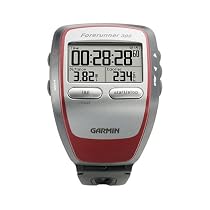
Excellent workout tool
I like this thing quite a lot. I've had it for about three weeks and have used it on 12 workouts so far. I use it primarily for running with biking a secondary usage. The main reason I wanted it was for the instantaneous readout of distance running pace and heart rate the latter needed for the speed work I want to do this running season.
The core functionality (distance and heart rate monitoring) works perfectly. There's none of the signal drops I've had with other heart monitors. Once the satellites are initially acquired I've only had one dropout when I was outside. The initial acquisition of the satellites can be quirky and can take some time. The accuracy (according to the readout) is +/- 25ft depending on how many satellites can be found. I've compared the distance measurement on the GPS with a known measured distance on one of the trails I run on (the Chicago lakefront path). The GPS always increments a mile when I'm within 5 or 10 feet of the mile marker sign on the path. Well I guess that's the least I should expect from a $350 GPS unit! Of course it's bigger than a normal running stopwatch but that hasn't bothered me at all. The heart rate strap is also very comfortable and well-designed.
The display is crisp and has one outstanding feature: The information presented on the various pages can be completely user-customized. The default screen layout is rather poor but in just a few steps I could replace it with the information I wanted to see while I run. There are almost 40 different data fields you can choose from for display. Examples: current pace average lap pace average run pace heartrate distance.
The only disappointment is the point-in-time (instantaneous) pace measurement: It varies wildly during a run. I see swings as big as +/- 3 minutes/mile. I'm a marathoner and I know my pace is fairly consistent during a run. I just looked at my run today and according to the data the first mile varied from 5:57/mile to 12:06 mile. I suspect the problem is either in the averaging algorithm (too short a distance?) or in the uncertainty that results from different satellites coming in and out of view. The variations seem to get worse under tree cover compared with an open area. Luckily there's a lap-average pace that can be presented and at least that value is useful and more accurate. The bottom line is that you can't look at the watch and say "right now I'm running 9 mins/mile". There is the ability to specify a pace smoothing factor but I have it maxed out and still see the variations. The elevation readout also seems inaccurate but that isn't important to me.
Upload of workout data to the PC software (Training Center) is transparent. The PC software is very good for presenting time/distance/pace/heartrate/calorie data. However the maps it shows are very crude. I've worked a bit with one of the online subscription services (MotionBased). That looks really good and provides some additional functionality beyond the included Training Center software although I still haven't decided if it's worth the $$$ yet for long-term data storage. MotionBased allows export to Google Earth and it's tremendously cool to see your running path superimposed on a satellite image. You can recharge the unit through the USB port on your computer although it's slower than using the dedicated recharger.
I had hoped that owning this device would prove motivational for me and indeed it has. I can't imagine running or biking without it. Updating my training log is trivial now: Plug this thing into my computer and it's done. My hope is that a future software update will do something about the pace calculation (maybe a few additional levels of smoothing?). If so the Forerunner 305 would earn 5 stars+++.
Positives:
Flawless heart rate sampling
Great distance measuring and lap-average pace calculation
Seamless integration with a PC
Fully-automatic training log update
User-customizable display
Negatives;
Wildly-varying pace readout.
More detail ...